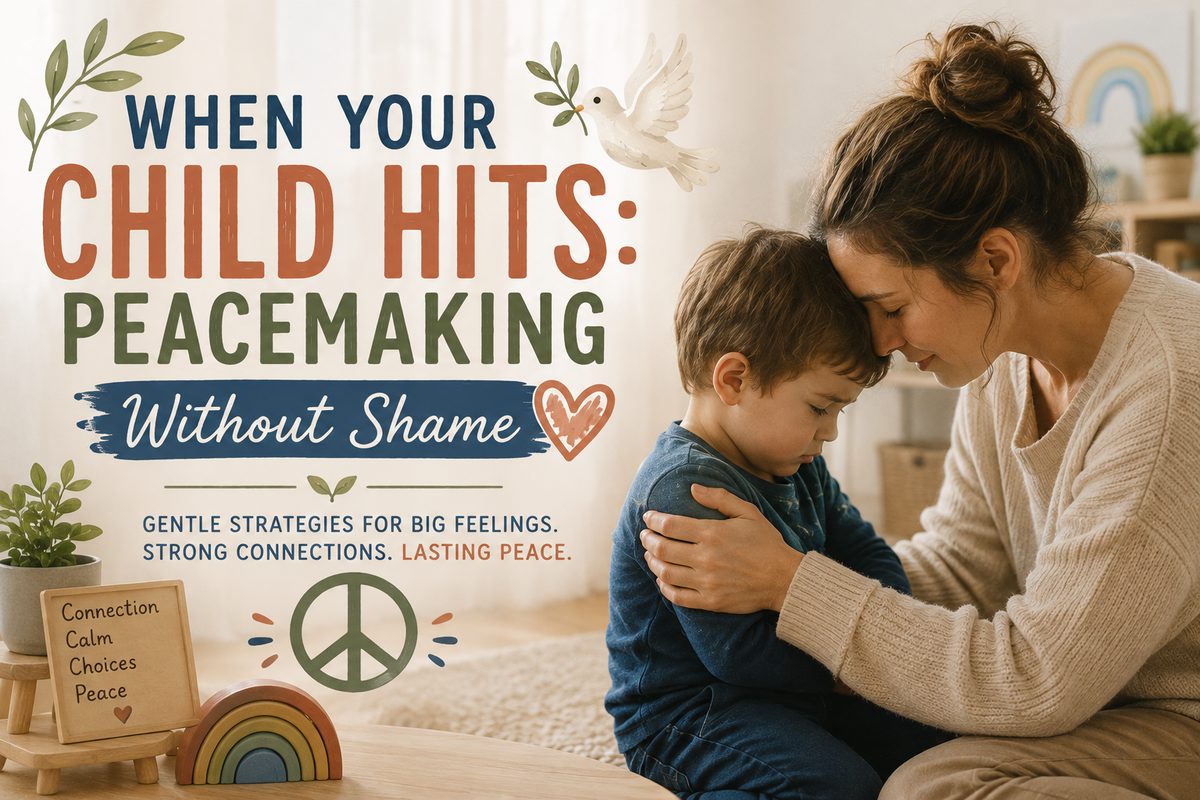
When Your Child Hits: Peacemaking Without Shame
Your toddler hits their sibling. Or you. Or a kid at the park who wouldn’t share the damn shovel. Your stomach drops — partly from the sting, partly from the flash of am I really raising this? — especially when you’ve hung the “peacemaker” sign over your parenting values.
Take a breath. Hitting is not a moral failure, in your child or in you. It’s one of the most developmentally normal things a small child does. Here’s how to respond in a way that actually teaches, instead of just reacts to the behavior.
First: Hitting Is Communication, Not Character
A toddler who hits isn’t a “violent kid.” They’re a kid whose feelings arrived faster than their words or self-control could keep up. The prefrontal cortex — the part of the brain responsible for impulse control — doesn’t finish developing until the mid-20s. Hitting at age two or three isn’t a preview of who they’ll become. It’s a snapshot of a brain that hasn’t built the tools yet. If your child has ADHD/ADD or is some other flavor of neurospicy, this can be even more exacerbated.
Your job isn’t to shame the impulse away. It’s to build the tools to manage it.
In the Moment: Three Steps
- Stop the hand, not the child.
Gently but firmly hold or block the hitting hand. Keep your voice calm and low, not sharp: “I won’t let you hit. Hitting hurts.” You’re setting a boundary, not delivering a moral verdict. - Name the feeling underneath.
“You’re really mad he took your truck.” This does two things: it de-escalates (feeling seen calms a dysregulated brain faster than being scolded), and it starts building the emotional vocabulary that will eventually replace the hit. - Redirect to repair — don’t force a scripted “sorry.”
A four-year-old forced to mumble “sorry” while glaring isn’t learning empathy — they’re learning to perform an apology to make the adult stop talking. Instead, invite repair: “Your sister is still sad. What could you do to help her feel better?” Sometimes that’s a real apology. Sometimes it’s a hug, fetching an ice pack, or just sitting nearby. Let it be genuine, even if it’s small.
What Not to Do
• Don’t hit back “so they know how it feels.” This teaches the opposite lesson: that hitting is how bigger, stronger people solve problems.
• Don’t demand an instant apology. Big feelings need to come down before words can go up. Give it a minute.
• Don’t shame the child’s character. “You’re a bad boy” attacks identity. “Hitting isn’t okay” attacks the behavior. Kids can change a behavior. They internalize an identity. Which do you think messes them up emotionally more?
After It’s Over: Build the Tools for Next Time
Once everyone’s calm — not in the heat of it — this is prime teaching time:
• Practice the words they needed. “Next time you’re mad, you can say ‘I’m mad!’ really loud, or stomp your feet, instead of hitting.”
• Role-play it. Use stuffed animals to replay the moment with a different choice — this is where a lot of real learning happens, away from the emotional charge of the original event.
• Give their body something to do with big feelings. Squeeze a pillow, stomp on bubble wrap, do “gorilla stomps” across the room. Kids need a physical outlet for physical feelings — asking them to just “use their words” while their whole body is activated is often asking too much, too soon.
A Note for the Parent
If your own reaction to being hit is a flash of anger or panic, that’s normal too. Pause before you respond if you need to. Modeling your own regulation — “I’m feeling frustrated, I’m going to take a breath” — is one of the most powerful peacemaking lessons your child will ever witness, and you get to give it to them by simply narrating your own process out loud.
If you were spanked as a kid (especially if you were spanked as a kid) the urge to spank your own child when you’re at your limit isn’t a character flaw — it’s a groove worn into your nervous system by repetition. Your body learned, early and without your consent, that a swat is what happens when a parent runs out of patience.
That means the impulse can show up faster than your thinking does, especially when you’re exhausted, embarrassed in public, or hit with a memory of your own parent’s voice. The way through this isn’t willpower in the moment — it’s a plan made in advance. Notice your own warning signs (clenched jaw, raised voice, the urge to “make them stop right now”), and have a pre-decided move ready: step back, put your hands in your pockets, count to ten out loud, or say “I need a second” and physically leave the room if the child is safe to be left alone. Every time you catch the impulse and choose something else, you’re not just parenting differently — you’re rewiring that old groove into a new one—choosing peace over violence, just like you are trying to teach your child.
Hitting isn’t a sign you’re failing at raising a peacemaker. It’s the raw material peacemaking is built from — one calm, repeated response at a time.
Next stop: teaching kids to say sorry and mean it.