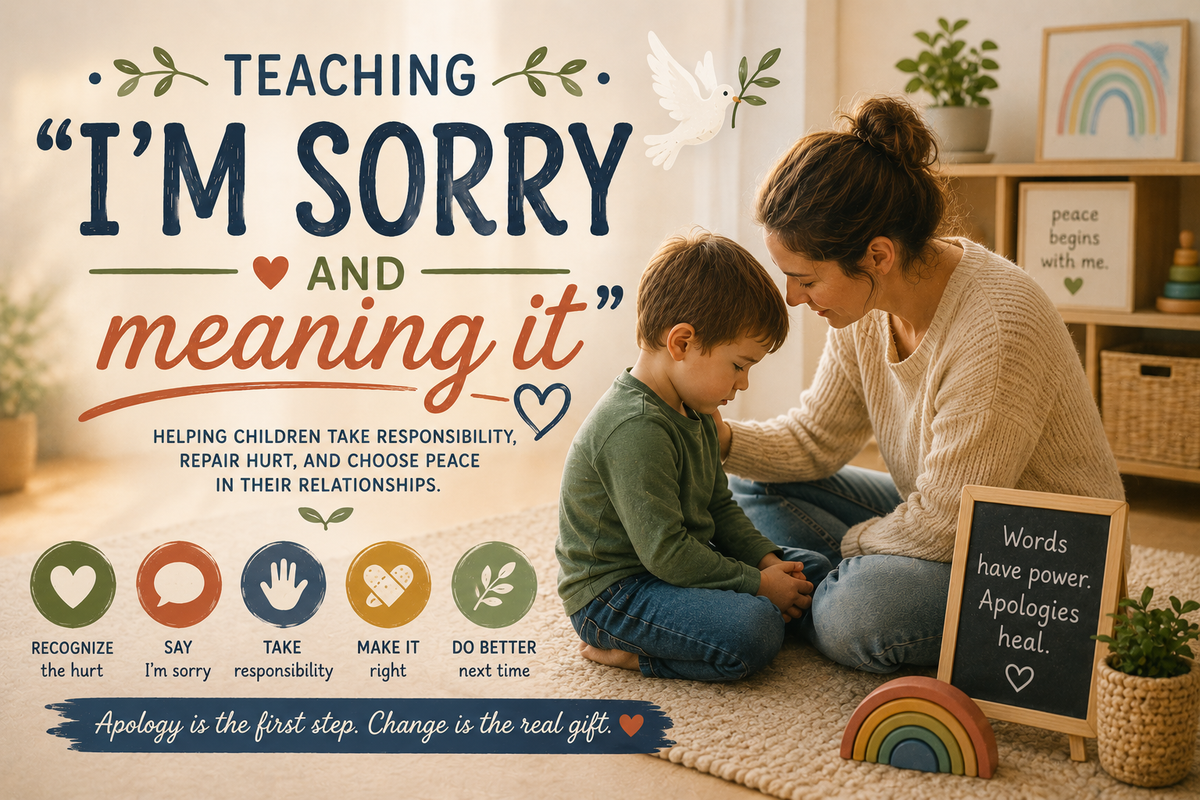
Teaching “I’m Sorry” And Meaning It
Most of us learned to apologize the same way: an adult said “say you’re sorry,” we mumbled it while staring at our shoes, and everyone moved on. It got the words out. What it didn’t do was build empathy — it built a habit of performative remorse to make an uncomfortable moment end.
If we want our kids to grow into people who repair relationships instead of just closing them, “sorry” has to mean something. Here’s how to get there.
Why the Forced Apology Doesn’t Work
A forced apology asks a child to produce an emotional state — remorse — on command, often while they’re still flooded with anger, embarrassment, or defensiveness. Most kids (most adults, honestly) just can’t do that. So they fake it. And every time they fake it successfully, they learn that the words are what actually matter, not the feeling behind them, and not the actions to repair the wrong.
Real apologies come from empathy — understanding that you caused someone else pain. Empathy takes a beat to arrive. Rushing a child to “say sorry” within seconds of a conflict skips the one step that would have made it genuine.
What to Do Instead
- Separate the apology from the moment of conflict.
Let big feelings settle first — for both kids, if it’s a sibling conflict. You can say, “We’ll check in on this in a few minutes,” and mean it. - Ask questions instead of issuing commands.
Instead of “Say you’re sorry,” try: “How do you think she felt when that happened?” and “What do you think she needs right now?” This does the actual work of building empathy, and often, a real apology follows on its own — because the child arrived at it themselves. - Widen what “repair” can look like.
Sorry is one repair option, not the only one. A hug, fixing what got broken, helping rebuild a knocked-down block tower, or simply asking “are you okay?” all count. Kids (and adults) don’t always have “sorry” in them in the moment, but they usually have something. Let that something count as real repair. - Model it yourself — especially when you mess up.
This is the single biggest lever you have. When you snap at your child unfairly, narrate your own repair out loud: “I yelled, and that wasn’t okay. I was frustrated, but that’s not your fault. I’m sorry.” You’re not just apologizing — you’re showing them exactly what a genuine apology sounds like, including naming the feeling that caused the misstep. You don’t have to be sorry for the boundary-setting or the direction; you are sorry for the way you acted in setting it.
A Simple Script to Practice Together
For kids old enough for a bit of structure, try building an apology in three parts, and practice it during calm moments (bath time, car rides) so it’s already familiar when they need it for real:
•	What happened: “I grabbed the toy.”
•	How it affected the other person: “That probably made you sad.”
•	What I’ll do differently: “Next time I’ll ask first.”
This isn’t a script to recite by rote — it’s training wheels. Over time, kids internalize the shape of a real apology without needing the formula.
When They’re Not Ready to Apologize — And That’s Okay
Sometimes a child genuinely isn’t there yet, and forcing it just teaches performance. It’s okay to say to the other child: “He’s still feeling upset and isn’t ready to say sorry yet. I’m sorry that happened to you,” modeling that adults can hold space for someone else’s hurt even when the person who caused it can’t, yet. Circle back later. The goal is a real apology eventually — not a fake one right now.
An apology isn’t a magic word that erases harm. It’s a skill — noticing impact, naming it, and choosing to do better — and like every skill on this train, it gets stronger with practice, not pressure.
Next stop: what to say instead of “use your words” (because most kids don’t know which words).