Ten Peacemaking Activities: Montessori Style
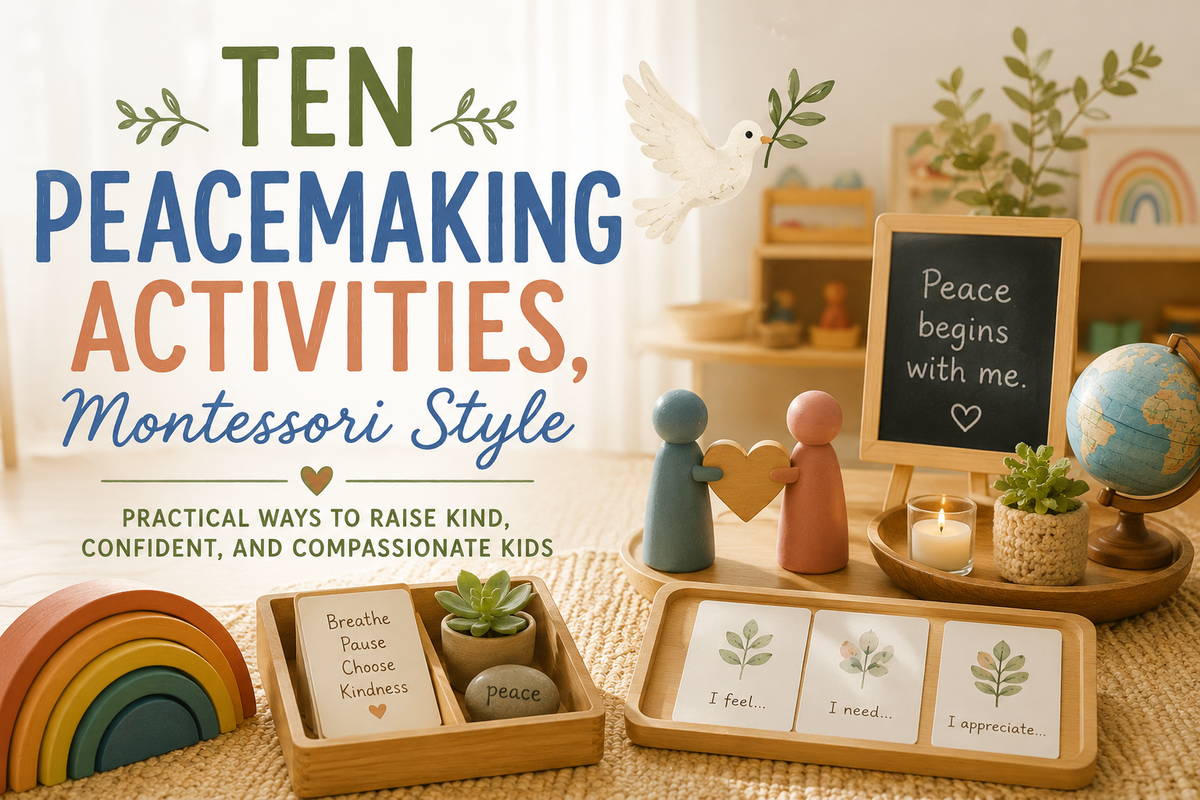
Montessori classrooms have been quietly teaching peace education for over a century — not through lectures, but through prepared environments, hands-on materials, and adults who model behavior rather than direct it. You don’t need a classroom to borrow these ideas.
Here are ten peacemaking activities you can bring home, all rooted in Montessori’s core principle: show the child, don’t just tell them.
- The Peace Table (or Peace Corner)
Set up a small, cozy spot in your home — a rug, two cushions, maybe a plant or a candle (battery-operated for the little ones) — where kids can go to work through a conflict together. It’s not a time-out corner. It’s a place for working toward something, not away from something. Model using it yourself when you and your child have a disagreement. - The Walking-the-Line Exercise
A classic Montessori grace-and-courtesy exercise: tape a line on the floor and practice walking it slowly, carrying something (a small bell or cup of water) without spilling. It builds the same body control and focus kids need to pause before reacting in a real world conflict. - Grace and Courtesy Role-Play
Montessori classrooms explicitly practice social scripts before kids need them in real life: “How do I ask for a turn?” “How do I say no thank you?” Pick one script a week and act it out together, silly voices encouraged to help memory, so it’s already in their body when the real moment comes. - The “I Statement” Puppet Show
Use two puppets or stuffed animals to act out a disagreement, then pause and ask your child: “What could this puppet say instead of grabbing?” Let them coach the puppet through an “I feel ___ when ___” statement. Rehearsing on a puppet is much lower-stakes than rehearsing with a sibling. - Silence Game
Sit together in complete silence for 30–60 seconds, just listening to the sounds in the room. This builds the self-regulation muscle kids need to pause and think before reacting — the same pause that turns a fight into a conversation instead of a grabbing-match. - Care of the Environment, Extended to Care of Relationships
Montessori kids water plants and wipe tables as a matter of course — the idea being that caring for your environment builds responsibility. Extend that concept: “How do we take care of our friendships?” Brainstorm together (checking in, sharing, saying sorry) and treat it as its own kind of daily care. - The Feelings Basket
Fill a small basket with objects, pictures, or cards representing different emotions. Each morning or evening, invite your child to pick one that matches how they feel and tell you why. No fixing required — just naming. This teaches two lessons: that emotions can be named without committing to them and that emotions are mutable. - Conflict Resolution Cards
Make a simple set of cards with kid-friendly steps: “Stop,” “Say how you feel,” “Listen,” “Find a fair fix.” When conflict happens, walk to the cards together instead of jumping straight to a lecture or a knee-jerk reaction. The physical act of choosing a card gives kids agency in their own de-escalation. - Community Circle Time
Borrow the elementary Montessori “circle” tradition: a regular sit-down (even just five minutes) where everyone — parents included — shares one high and one low from the day. It normalizes talking about feelings before they boil over into conflict. - Real Work, Real Trust
Montessori’s deepest peace lesson might be the simplest: give children real responsibilities (pouring their own water, feeding a pet, setting the table) and trust them to do it. Competence and independence reduce the frustration that often fuels conflict in the first place — a calm, capable kid has less to fight about.